

Among the Dead
Updated: Mar 24

February 26, 2025
"Yes, wonderful things."
— Howard Carter, in response to Lord Carnarvon asking if he could see anything peering a candle through a small opening in the tomb of Tutankhamun
We crossed the Nile River today to the West Side or “The Land of the Dead”. At least that is what our driver referred to it and I doubt the residents of this side of the river appreciate the sobriquet. The name comes from that this is the location of the multiple tombs of the various pharaohs, nobles, workers and commoners are located. The sun rises in the East, signifying life, and sets in the West meaning your time is over.
The villages we passed are decidedly poorer than the East side where most of the tourism industry resides. The East bank is mostly agriculture with sugar cane and alfalfa being important crops.
What is over here to see is outside the villages where the blasted rock and earth begins. The the murderous Sahara heat have killed all surface life. It is beyond the reach of the Nile irrigation and thus a dead zone. Perhaps the nickname fits after all.


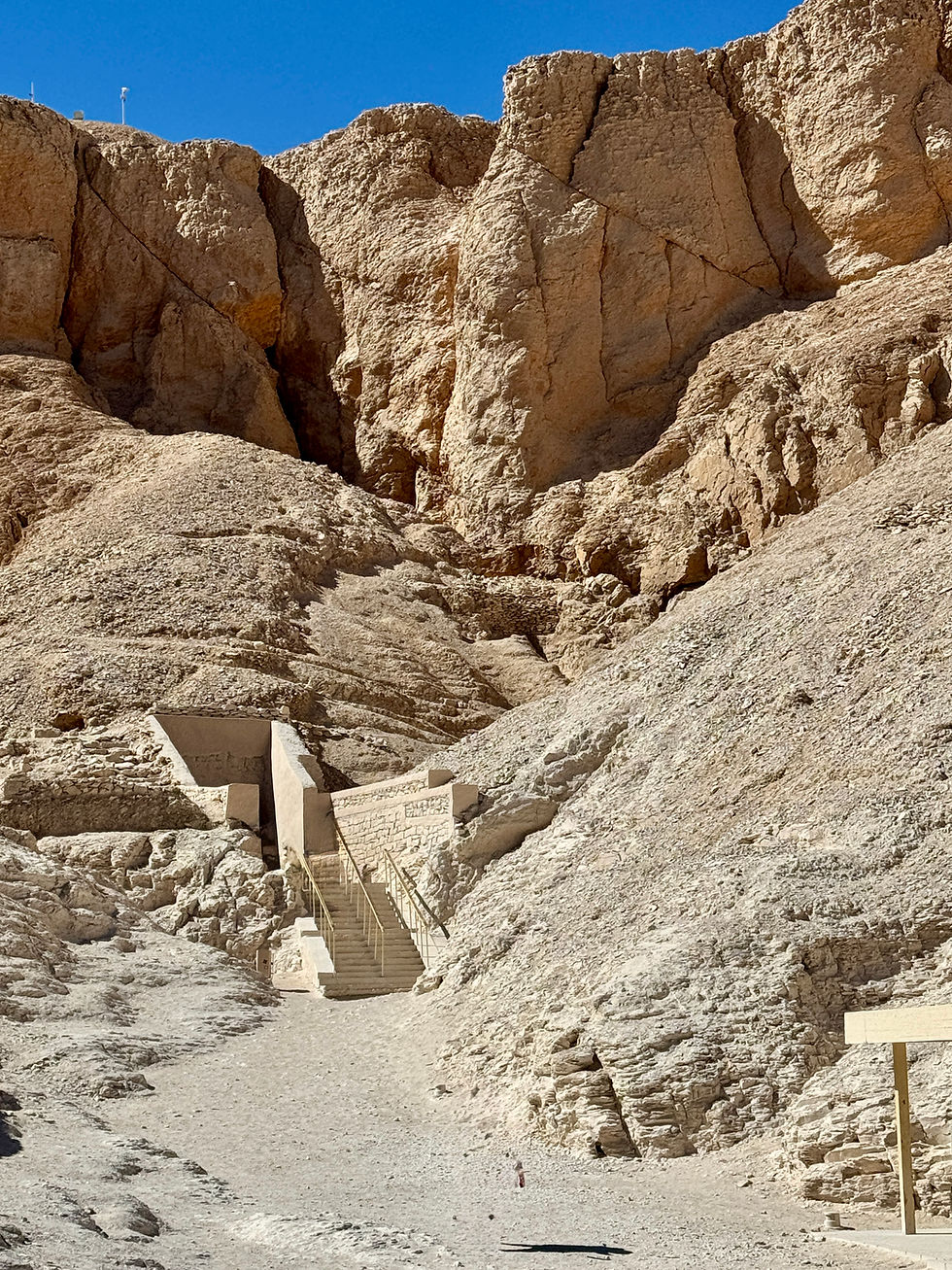
We were heading for “The Valley of the Kings”. Here over 60 Pharaohs are buried. In the 4th dynasty of Egyptian rule, the Pharaoh Khufu also wanted a tomb and built the Great Pyramids. As spectacular as they were, they were also a beacon for grave robbers. Those days were over 1000 years earlier from the time we are looking at here. These Pharaohs, bearing in mind the lessons of Khufu, wanted to hide their tombs so they could not be robbed.
It did not work. Every single tomb here was looted save one. More about that in a moment. You see, The Pharaohs believed you in fact “Can take it with you”. So a tomb would be loaded with his treasure, food, clothes, and even favorite pets. So when he awoke, he would have all of his nice things in paradise.

This background is what made the discovery of “King Tut’s” tomb so significant. He was not a great Pharaoh. He was young, reigned only 7-9 years, did not accomplish much, and was either murdered or died of malaria at age seventeen.
However, unlike all of his predecessors, his tomb was found intact with over 5,000 priceless items inside.
This discovery of King Tutankhamun’s tomb in 1922 is one of the most remarkable archaeological events in history, unveiling treasures that transformed our understanding of ancient Egypt. The tomb was uncovered by British archaeologist Howard Carter, working under the sponsorship of Lord Carnarvon.

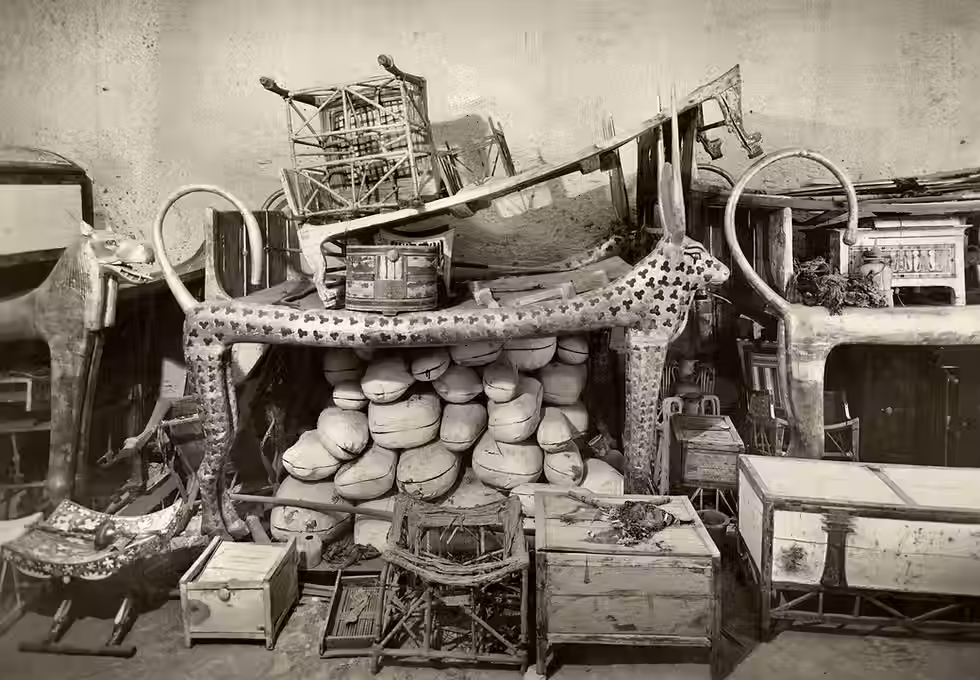

For years, Carter had searched for the lost burial place of the young pharaoh Tutankhamun, who ruled Egypt around 1332–1323 BCE during the 18th Dynasty. Many experts believed that all the royal tombs in the Valley had already been found, but Carter persisted. His perseverance was rewarded in November 1922 when his team discovered a step cut into the rock beneath the debris of earlier excavations. It was underneath an older tomb. After days of careful clearing, they revealed a sealed doorway stamped with the royal insignia of Tutankhamun.


On November 26, 1922, Carter peered through a small hole into the tomb by candlelight. When Lord Carnarvon asked if he could see anything, Carter famously replied, “Yes, wonderful things.” Inside lay more than 5,000 artifacts — golden chariots, statues, jewelry, and the magnificent gold mask that became an icon of ancient Egypt. The burial chamber itself was not opened until early 1923, revealing Tutankhamun’s nested coffins and the pharaoh’s mummy within a solid gold sarcophagus.


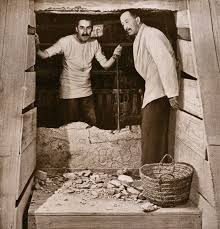
The discovery electrified the world, sparking a renewed fascination with ancient Egypt — often called “Tutmania.” It also reshaped Egyptology by providing an almost intact royal burial, offering unprecedented insight into ancient craftsmanship, burial customs, and daily life.
Here it is today -


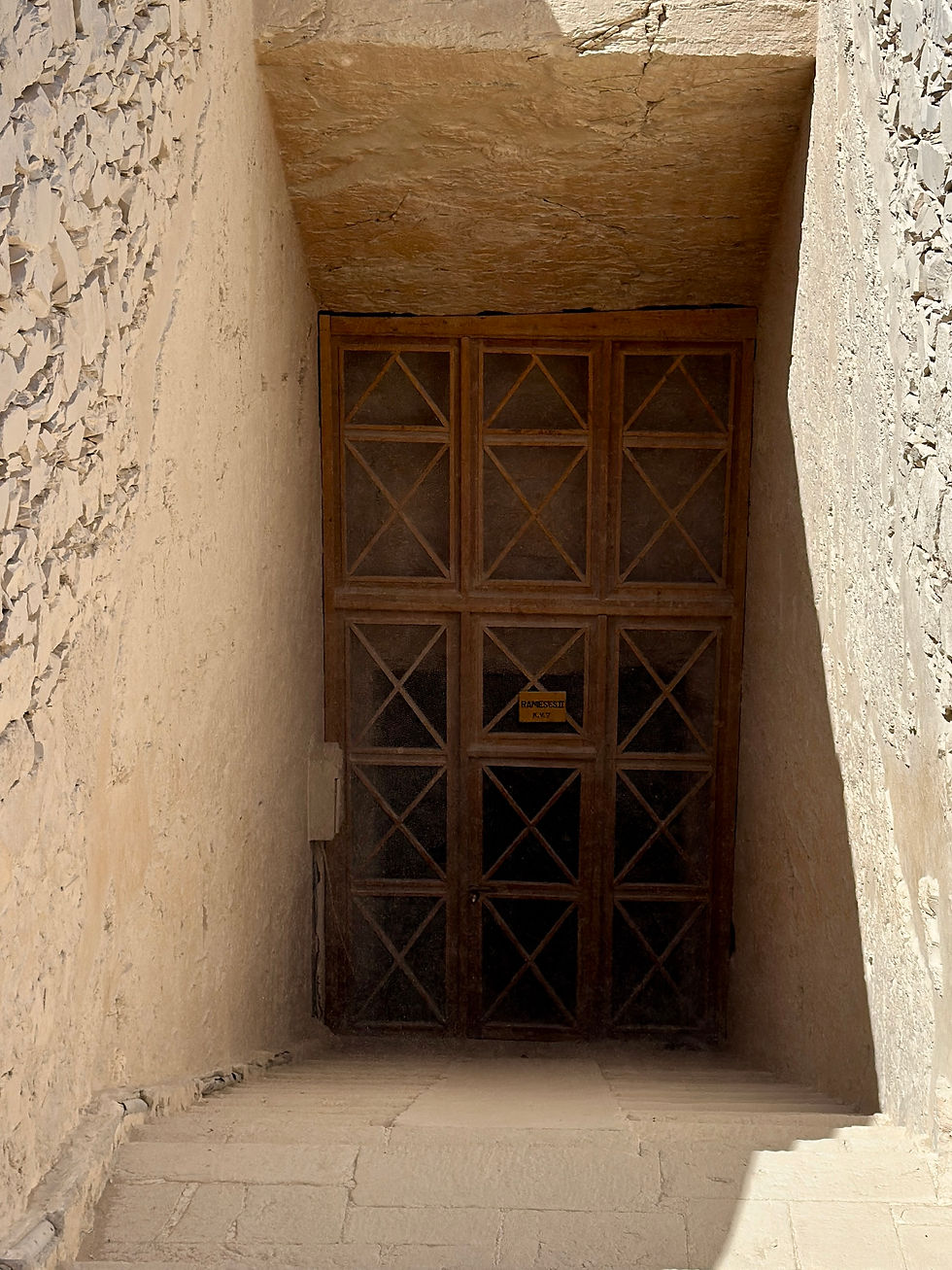
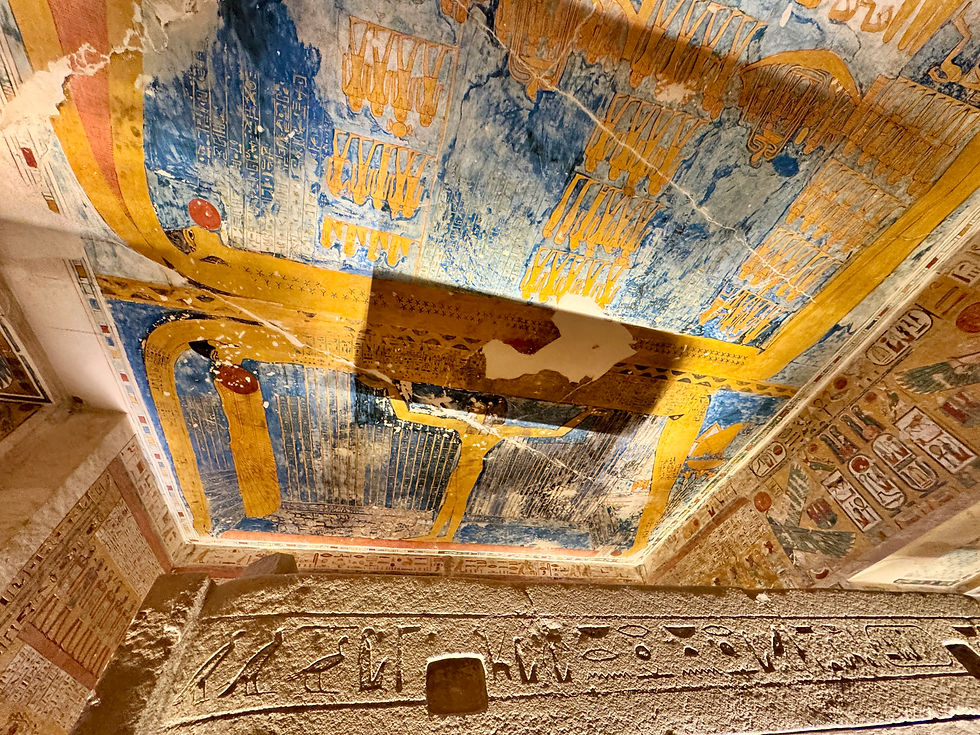
We visited several other tombs in the Valley. All had spectacular carvings and original color. Most of the hieroglyphs were reference to the Egyptian “Book of the Dead’. Essentially this was an instruction manual for the resurrected Pharaoh of what to do and how to get to his final resting place. The following are a series of images from those tombs.






Hatshepsut, a extremely rare female King, has her funerary here adjacent to the Valley of the Kings. So she had hers built against this sandstone edifice and literally drill into the other side.

Most of this building is a reproduction. When she was murdered about 20 years into her reign, her successor went to great lengths to purge her from any records of royalty. He was not successful. For some new research on her reign click here.
This stunning building was rebuilt in the 20th century.


Below is the Temple of Rameses III, the grandson of Rameses the Great, at Medinet Habu. It is a remarkable and arresting place and one of the best preserved royal cult temples in Thebes.
He lived and ruled from here.


Medinet Habu is covered with extensive hieroglyphic reliefs almost all of which offer testimony to the divinity of the Pharaoh. They also offer a record of his battles and supremacy over his foes. It is a unique and awesome display of propaganda that any despot from any era would envy.


We finished the day here at The Colossi of Memnon. These enormous 17 meter tall statues were destroyed by an earthquake many years ago. They were reassembled and serve as part of several statues that were once part of an enormous temple to Amenophis III that has been lost to the ravages of time.


The sun started to set and it was time for our guide to break his fast. We crossed the Nile again and headed back to the Eastern side and the land of the living.
In the coming days we will leave for Aswan, far to the south on the Nile River and deep into “Upper Egypt” where everything began.


Comments