

The Wisdom of Athena
Updated: Feb 15

February 13, 2026
“Tell them to stay calm, to breathe deep, and find beauty in unexpected places... look beneath the surface and hang tight”.
- Wisdom of the goddess Athena
One day the great god Zeus was suffering from an Olympian size headache. Nothing seemed to work to alleviate his pain. Recently, in an act of self preservation he ate another goddess Metis, his consort, who was pregnant at the time. The reason was it was foretold she would have a son that would one day rise up and defeat him.

In his discomfort he consulted Hephaestus, the great inventor and blacksmith of the gods. He was considered the most clever immortal Hephaestus suggested splitting Zeus’ head open with an axe so he could get a look inside and see what the problem may be. For a god, it seemed like a rational approach. So the great axe fell and from the wound arose a fully formed beautiful woman with grey eyes, a far way intelligent look, complete with a shield, and a long spear.

Zeus immediately felt better, his head of course healed faster than Wolverine and he named her Athena. She would take her place among the Dodekatheon as the goddess of Wisdom and Battle. She quickly became a favorite of Zeus.
One day there was a heated discussion between Poseidon, Zeus’ brother and god of the sea, and Athena. They were wagering on who would be the patron for a new city. They decided they would each offer a gift and whoever offered the best would win the prize. Some sources say King Erech, a mythical monarch, would judge the gifts and others report Zeus was to be the final arbitrator.
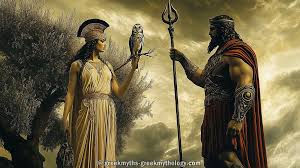


Poseidon went first. He took his mighty trident and struck the top of the Erechtheion temple passing through to the floor. There a bubbling spring of water came forth. But, it was seawater and not potable. Then Athena stepped up and planted an Olive tree, thus gifting mortals a precious resource. It was ,naturally, the wisest choice and the contest was over. Athena would be the patron goddess of the new city and Athens was born.


Or so the story goes.
Today we climbed the millennia old paving stones of the Acropolis, the great fortress hill that is the center of Athens.
Before we went into the gate there was something else to see. Nearby lies a hard piece of jagged limestone pushing up out of the rock called Mars Hill. Some time in 49-51 CE a 40 year old Apostle Paul climbed this rock and preached the sermon described in Acts 17.


Paul records, "Now when they heard of the resurrection of the dead, some began to sneer, but others said, “We shall hear you again concerning this.” So Paul went out of their midst. But some men joined him and believed, among whom also were Dionysius the Areopagite and a woman named Damaris and others with them.”

What is remarkable is not only the message of the famous sermon, but the fact he was tolerated and encourged to debate other philosophers in the audience. It was a stunning act of tolerance right here on this ancient rock.
We proceeded onward to the gate.
In the 5th century BCE, Pericles the King was enjoying the beginning of the Golden Age of Greece. This was a period after the defeat of the Persians. Pericles decided to dip heavily into the funds that were supposed to be used for defense and build something on top of the hill to celebrate the victory over the Persians.

To do so he hired this fellow, Iktinos, as the Architect and the best sculptor in the world, Phineas, as the lead artist.


This is the Propylaea or gate to the grounds. If it looks imposing, it was designed that way. Try to imagine a commoner of the time approaching this gate and what that structure would do to you. You must have felt genuine awe and fear.

On one side perched high up is the small temple of Winged Nike, a Demi goddess that served Athena. It was to further celebrate the Persian victory.
This pedestal is the Agrippa Monument. At times over the the centuries it supported various statues of people who wished to be associated with the Parthenon. At one time it even had a statue of the Roman Marc Antony and his consort Cleopatra, the Queen of Egypt.

Athena, the goddess of battle led them here so the choice was easy. A grand temple would be built dedicated to her. But this would not be just any temple. It would ultimately be the finest temple anywhere in the world and serve as a beacon for the city. This is the Parthenon.

It is hard to state in words the marvel they created without any slave labor. At that time, their was no such thing as architectural plans. They had to figure everything out on site using ingenious mathematics and precision engineering. The result was stones and columns so precisely laid together that you cannot get in-between the seams. The marble stones were quarried at a mountain many miles away and were transported with grueling manual labor up to this hill.


The Parthenon took only 10 years to build. (Using modern equipment, the current renovation project has been going on for more than 20 years). It was 228 feet long and 110 feet wide. The entire footprint covered 23,000 square feet. It was full of clever optical illusions with a slightly curved floor, and 34 foot soaring columns that bent ever so slightly inward. To the eye, this created the feeling the the platform was straight despite being on a curved hill top.


At the East end of the completed structure rose a sculpture of Athena carved by Phineas over 24 feet high. It was covered in 1 ton of gold that was over 3 inches thick.

In the middle ground of the Acropolis on the North side there is a field of rubble. These stones were from an even earlier temple to Athena that predated the Parthenon. It was torn down by the Persians as an affront to the locals. The Greeks vowed to never build over it as a monument to the sacrilege.

Across from the Parthenon lies the smaller elegant temple called the Erechtheion. It was here, according to tradition Athena and Poseidon had their wager. Athena’s olive tree is still planted there and on the north porch you can still see the hole in the roof and the defect on the floor where Poseidon’s trident stuck. (See the pictures above)
The Erechtheion is best known for the porch of Caryatids. These exquisite sculptures of women in the classic contrappose pose serve to support the roof. The fluting of the columns form the structure of their robes.


The Parthenon was so well built that it has survived the ages despite the ravages of various invasions and occupiers who wanted to put their own look here. At various points it was vandalized, the great statue of Athena stolen and lost to history, it was made into a church, and later when the Ottomans invaded made into a Mosque complete with a minaret.
However on September 26, 1687 the Venetians had invaded. They cared little about historic preservation, they just wanted to defeat the Ottomans who were hold up under siege on the Acropolis. From a hill nearby, they fired crude mortar artillery shells at the site. One lucky hit struck the Parthenon where the Ottomans had a store of gunpowder. The result was a catastrophic explosion shattering the South side of the structure that you can still see today.


In 1801, the British Ambassador Lord Elgin “Purchased” priceless marble statues from the friezes atop the Parthenon and carted them away to the British Museum in London. Greece wants them back. We saw them way back in Episode I
Today, the influence of this magnificent building continues. The architecture has influenced countless buildings. A simple walk through Washington DC gives ample testimony to this fact.

But it is more that that. When Prometheus gave humans fire, it also sparked the ability to create. Here in Greece, the people were, however briefly, turning away from war and endless conquest. Instead, the focus became education, philosophy, mathematics, and art of such beauty that the rest of the world would copy it for untold generations.

You feel the wisdom of that focus walking among these old stones.
You see Athena.


Comments