

Among the Ruins

February 14-15, 2026
“He who is unable to live in society, or who has no need because he is sufficient for himself, must either be a beast or a god.”
—Aristotle
Oh I have heard it before. When I go on these trips I obsess over history details as if everyone would find them as fascinating as I do.

They don’t. I get it.
We were in a taxi yesterday with yet another loquacious driver. He asked if this is our first time here and, when he discovered it was, proceeded to tell us the best things about Greece were not found here in Athens.
“You must go to the Islands”, he advised. "There you will find sun, beach, girls, and more!" Not once did he mention the amazing historical locations that dot this city.

I am so boring. Bless my wife for these past 43 years for the patience to put up with my ingrained nerdish soul.
These last two days we spent time once again exploring the many ruins here in the old city.
This is the Agora. This area was essentially the public square of the city. Here Athenians would gather to shop, conduct business, and socialize. When you have a large enslaved population to do the menial labor it is easier to be idle and discuss big ideas.

Most of it is gone, lost to looters and the ravages of time. So you have to use your imagination a lot as you look at the stone outlines on the ground.
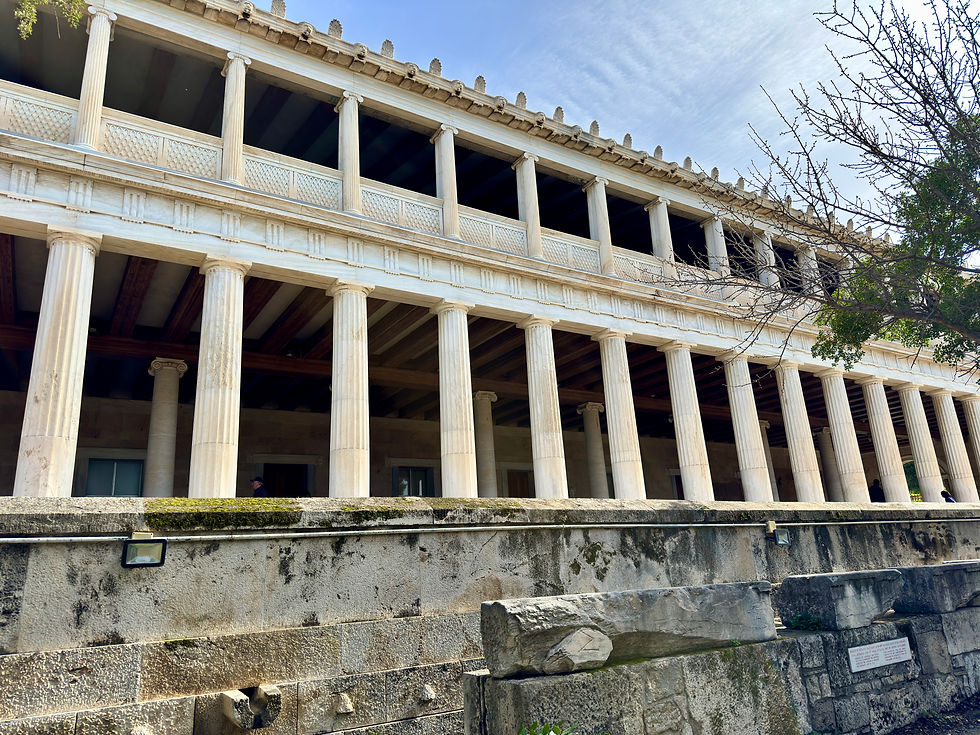
This large building is a faithful reproduction, built in the 1950’s, of a Stoa. It is essentially a shopping mall with a large covered porch to protect you from the rain or hot sun. Here you would linger and discuss the days events. It was here on a porch just like this that Socrates, Plato, and later their disciple Aristotle would stroll and challenge passers by with thought provoking questions. These daily sessions would form the beginning of Western thought and civilization. Ideas about individual rights, democracy, and what it means to be human started here on this porch.

The field here in front with the multiple rocky debris used to be an open grassy field. When the Romans occupied Athens in 156 BCE they built a theatre here. Before this elaborate set up, which should seat over 1000, plays by Aeschylus, Sophocles, and Euripides were performed here regularly out in the open. It was the birthplace of modern theatre.


The well preserved temple below is dedicated the the Greek god Hephaestus. It is about 1/3 the size of the Parthenon. Hephaestus was the god of fire, metalworking, stonemasonry, and sculpture, known as the master craftsman of the Olympians and husband to Aphrodite. Son of Hera (sometimes with Zeus), he was cast from Olympus due to a disability, yet returned to create legendary weapons and armor. His Roman counterpart is Vulcan.


As a demonstration of the co-opting of Greek culture we see this statue of the Roman Emperor Harridan. If you look at the breastplate of the armor you will see at the base the classic Romulus and Remus being suckled by the She Wolf as the founding symbol of Rome. But just above it rises Athena, the patron god here with her symbols of the owl and the snake.

There is a medieval church here dedicated to the Apostle Paul who, when not up on Mars Hill, would come here to the Agora to debate local people. They listened. Not everyone agreed with him but the simple fact the discussions took place freely, in the open was remarkable. These old rocks have stories to tell.


One more thing. This humble circle with the rock in the center was the Tholos, the center of Greek government. In its time it looked like the rendering below.
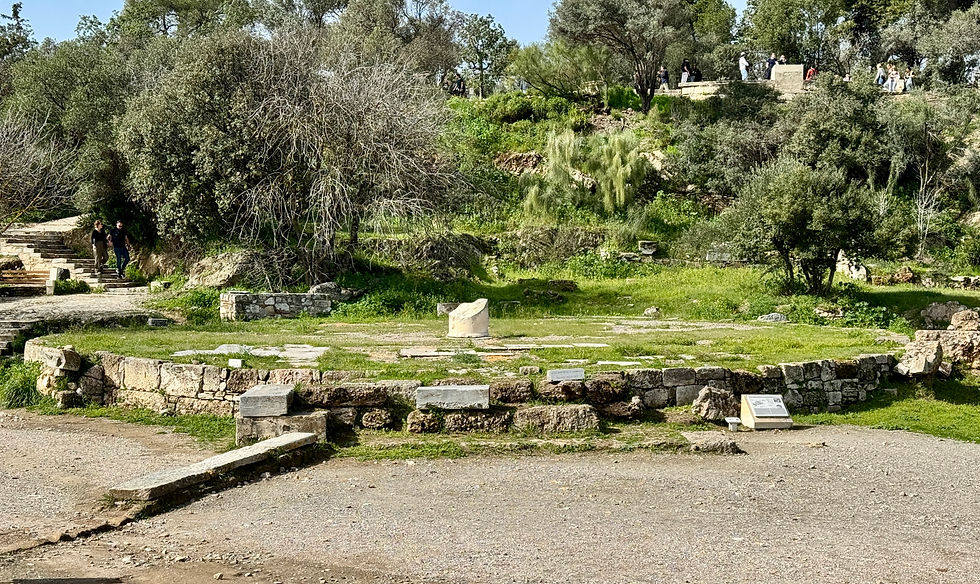

It was here that men met and voted on what to do about the issues of the day. Outside, on the grassy field, hundreds would meet and choose who would be among the 50 who would go in this round building to lead the City.
Here was the beginning of democracy.

It was by no means perfect and hardly representative. Only free men who were citizens could participate. No slaves, no foreigners, and most importantly no women were allowed.
But, it was a start.
It did not last. As utopian as the “Golden Age of Greece” sounds they could not protect it. Alexander the Great for one quickly disolved such an institution as democracy. Greece would give way to the forces of other authoritarian rulers, occupying armies, commercialism and more. It is an old story that still plays out today. It all can be lost so easily.

Despite these humble old rocks, there is a lot to see here among the ruins.

For a deeper dive, here is a lecture by the famous travel writer Rick Steves about travel and American democracy. He warns us that all of this has happened before and all of it can happen again.


Comments