

Nothing But Olive Oil And A Little Dust

February 19, 2026
“Without doubt, the athlete of Olympia was protected, to a certain point, by the sacred nature of the exercises in which he engaged, and the crown of wild olive placed on the victor's head remained a symbol of selflessness and the chivalrous spirit.”
Baron Pierre de Coubertin
“Say Billy, ever seen a grown man naked?”
Airplane - the Motion Picture 1980
“It is very difficult for men to run while naked, because their parts flop around. It is not easy for us to be graceful when we are naked.”
- A Heartbreaking Work of Staggering Genius by Dave Eggers
We drove West until we came to the Ionic Sea. We were seeking ancient Olympia, the home of the original Olympic Games. Olympia was a religious pilgrimage in ancient times. It was the focal point of Greek gods worship and its largest temple was there. People did not live there. In fact the nearest town was 30 miles away. Olympia had a monastery and the great temple of Zeus - one of the original seven world wonders.

The original games were acts of worship to Zeus held every four years. The exact origins of the completion is lost to time, but for over 1,000 years the games were a unifying force for the country and a culmination of a pilgrimage. There was a political purpose here. The games helped far flung city states communicate and promoted Pan Hellenic Culture. They were so revered that even when city states were in conflict, which was often, they would pause any fighting to allow attendance of the games. The first games that were held in which the results were recorded were held in 776 BCE.

The other interesting feature was how democratic they were. Anyone could participate as long as they were male and free. Greek culture placed great emphasis on athletic ability and training not only as an act of worship but it also served for military training.
When you enter the site one of the first structures you see in the gymnasium. Contestants would train here.


And they would train and participate naked.
In fact the word “gymnasium” comes from the Greek word Gymnos which means ‘naked’.
“Just rub yourself with olive oil and some dust to protect from starches”, was all their was to your uniform, according to historians. So as you walk among these ruins it is hard to imagine the place overrun with naked oily men covered in dust.


As part of the ritual each athlete would be lead to the temple and made to stand on castrated Bull’s testicles and swear an oath not to cheat. (I am not making that up). There were statues of well known cheaters on the way to the stadium that, as part of the tradition, were spat upon as you entered.

At first, the only contest was a foot race only. As time went on, other events were added including javelin throwing, discus, and wrestling.
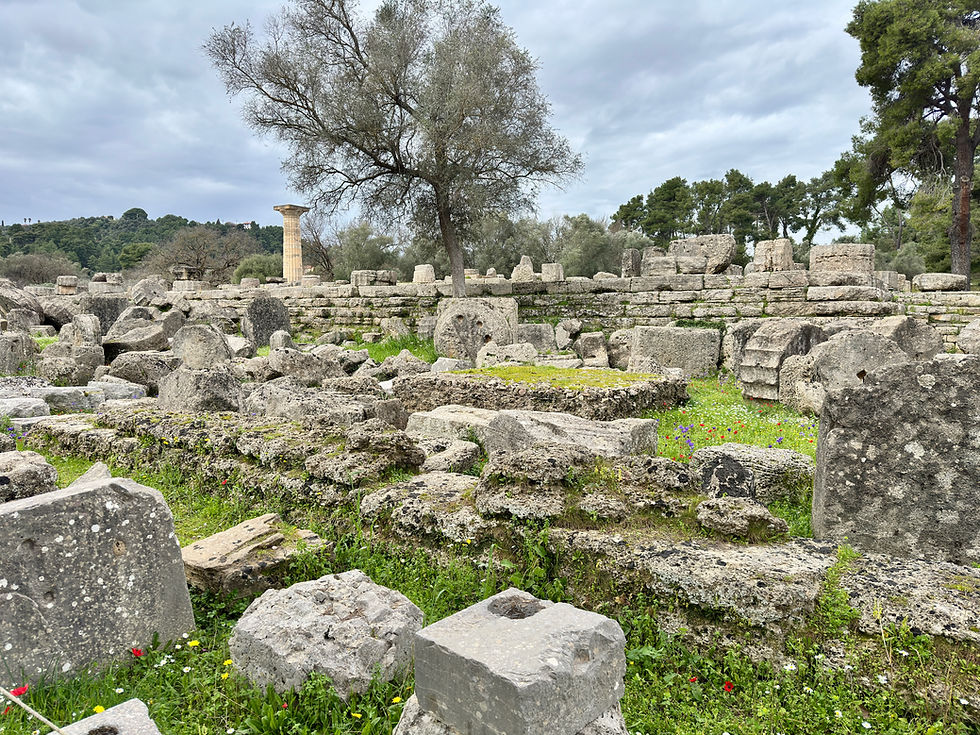
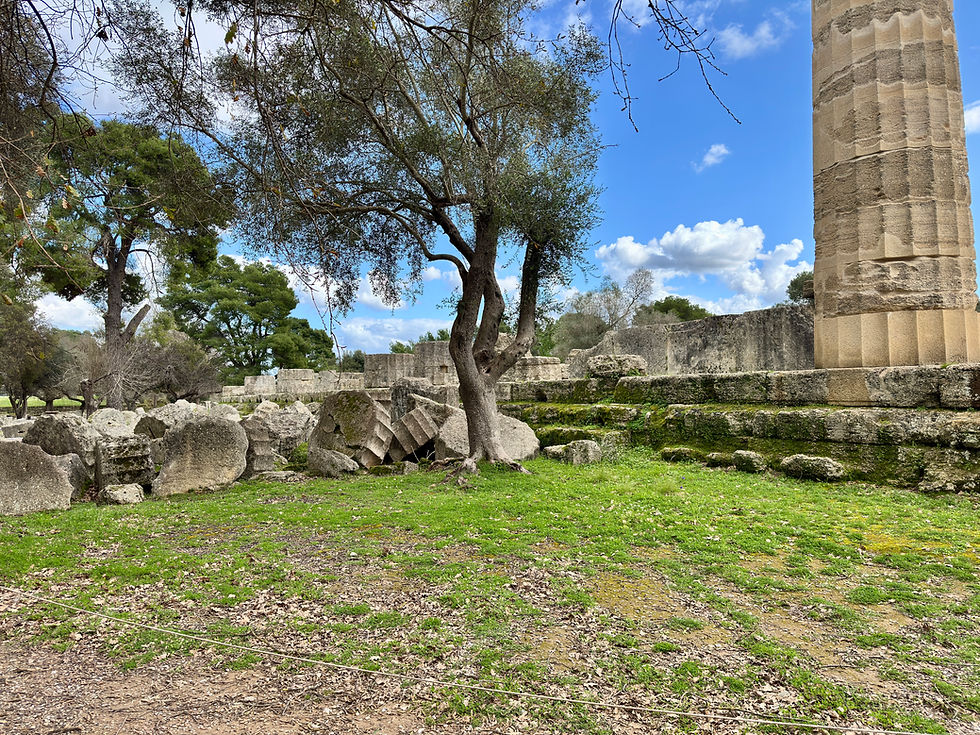
These large ruins are all that is left of the once great Temple of Zeus. It was toppled by an earthquake in the sixth century CE. The great 34 feet high doric columns lie tumbled over in huge stacks each weighing 9 tons. It looks like a child shoved them over.
Inside was housed Zeus. The enormous statue was meant to evoke awe. It was one of the Seven Wonders of the Ancient World, a 42-foot-tall, ivory-and-gold chryselephantine sculpture of the Greek king of gods, created by Phidias (The same sculptor of the statue of Athena in the Parthenon) around 435 BC.
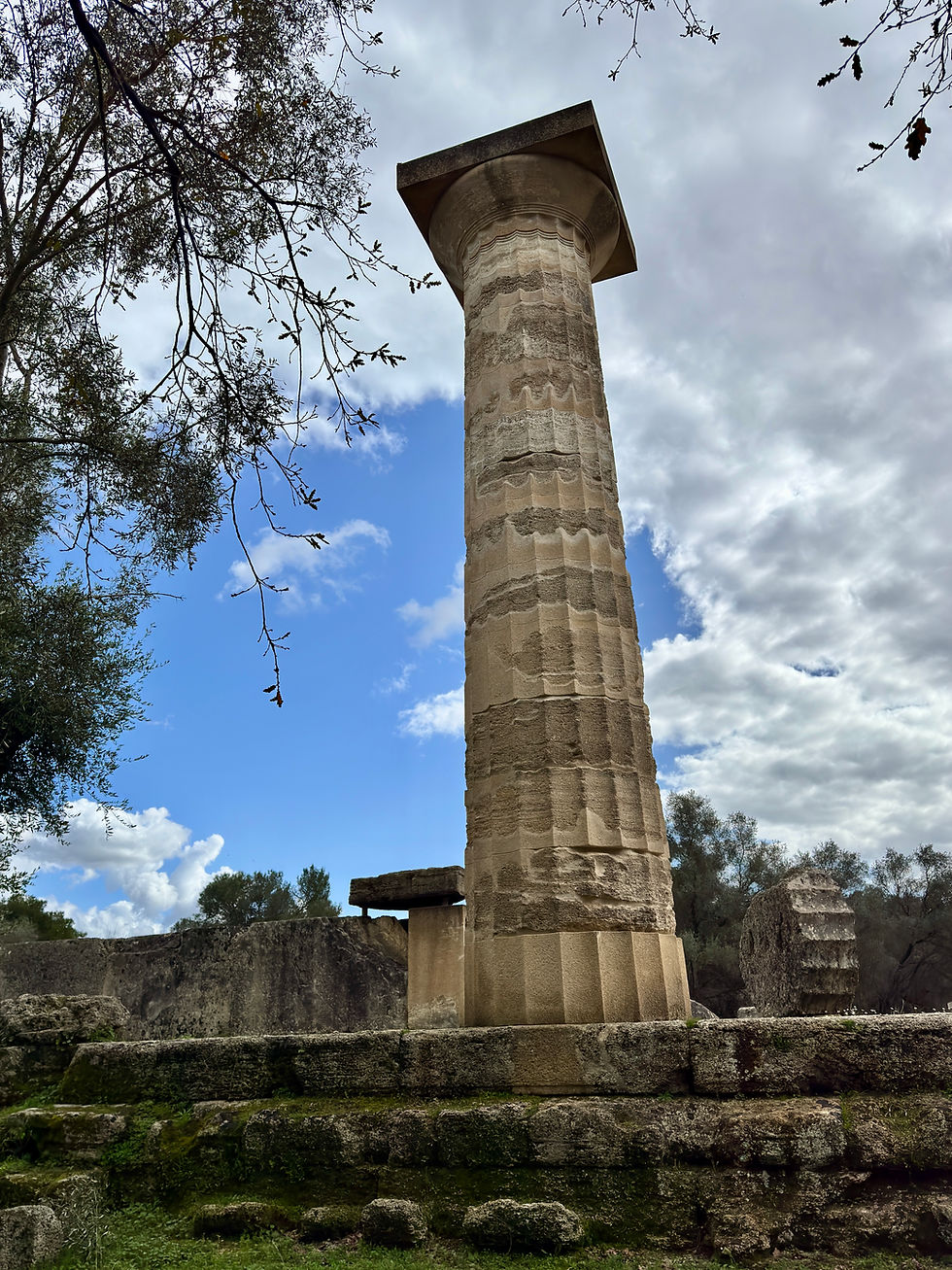


Seated on a cedar wood throne, the sculpture depicted a majestic Zeus holding Nike and a scepter. It was lost in the 5th-6th century CE. No one knows what happened to it but it likely fell victim to looters or fire.

The winners of events were led to these steps in front of the temple and awarded an Olive Wreath in front of cheering onlookers. No matter how humble their origins, if you won you were covered in glory. Your name was recorded here and you never had to buy your beer again at the tavern. Their was no such thing as second or third place. All that mattered was if you won.


The stadium itself was entered through a tunnel to a carved out field. Spectators sat on the grass while the judges sat in a special box. The place held 45,000 people, almost always men and boys.


The original starting line is still here. The race was up and back. The track was 640 feet long and, according to tradition, laid out by Hercules himself.


The last games held here were in 393 CE. With the coming of the Romans the games changed from a religious emphasis to loud, commercialized, bombastic events. Where the Greeks celebrated the beauty of the human form and the simple elegance of running like the wind (albeit buck naked), the Romans prized blood sports, killing, and gladiators.
In 393 CE, the ultra Christian Emperor Theodosius abolished the contests as part of a general purge of pagan festivals. (Interestingly, this was the same guy who instrumental in establishing the Nicene Creed as the orthodox doctrine)

People but their clothes back on, olive oil merchants went out of business, and these once great buildings fell into ruin. All that remained was the poppies.


Comments