

Mycenae
Updated: Feb 20

February 18, 2025
“The first great Greek powers were the Mycenaeans who were basically pirates at first: they sacked Phoenician boats, rammed Cretan ships, and soon had enough goods to go into business for themselves. Around 1500 BCE, they destroyed the Minoan civilization on Crete. Their stories describe this as a war with an evil king Minos who kept demanding that the Greeks deliver virgins to him every year until finally the great Greek hero Theseus went over and crushed the bastard and, just to salt the wound, made off with his (virgin) daughter. The Cretan version of this event would probably be different, if we but knew it.”
― Tamim Ansary, The Invention of Yesterday: A 50,000-Year History of Human Culture, Conflict, and Connection
The Trojan War is the founding myth of Greece. A great epic tale of heroes, gods, love, jealousy, adventure, glory, loss, and mere mortals faced against impossible challenges. I am speaking of course of the great poems by Homer of The Iliad and The Odyssey written around 750-700 BCE. These works are central to the beginning of the later country and western literature. They were beloved and gave the Greeks a strong sense of what would become their national identity.


Everyone knew the tales and everyone wanted to get learn more even centuries before Christ. So it is today, we traveled to Mycenae, the home of “Agamemnon” and the people who fought in the fabled war.

You see, it was the Mycenaeans (Not the ‘Greeks’) who fought against Troy. The ‘Greek identity would not come for many centuries. This formidable hill top was the home of their people and the capital of their empire - whose trade routes reached as far as Scandinavia!
It was a very windy but sunny day when we drove out to the site. The complex is strategically situated on a hill overlooking the Argos Valley and the sea beyond. A good source of fresh water and deep ravines on beach side make Mycenae quite defensible.

The architecture is interesting. This place was built long before the sturdy Roman arches and concrete. Cyclopean architecture is a type of Ancient Mediterranean masonry characterized by massive, rough-hewn limestone boulders fitted together without mortar, often with smaller stones filling the gaps. The term refers to the belief that only the Cyclopes of mythological fame could move such enormous stones.


The lintel stone over the Lion Gate alone weighs 18 tons which is as much as a B 17 bomber.

While huge and massive, cyclopean design is not as strong as later designs. It is remarkable that any of it is still standing.
This is the Lion’s Gate, guarded by two female lions and a symbol of the Mycenaeans.

Just inside to the right you find a grave circle where 19 bodies (9 women, 8 men, and 2 children) were found by Heinrich Schliemann, a self styled “Indiana jones” in 1876.


In reality Schliemann was a rich bored German industrialist who wanted to prove the battle of Troy was real. He was a terrible archeologist with no formal training. Instead of pain staking documentation and careful excavation, he often used dynamite.


Still, his determination was laudable when he arrived here and found the above bodies and about 30 pounds of gold objects buried with them. He immediately labeled the find “The Death Mask of Agamemnon” and this site was his palace. It caused a world wide sensation.

He was wrong. Careful study shows that the bodies and treasure had nothing to do with Agamemnon and were dated far after the alleged battle
Schliemann would go on to what is now western Turkey and discover a site at Hisarlik that he labeled Troy. Again, his dating was wrong and the site held over seven layers of civilization and he found only the second layer.
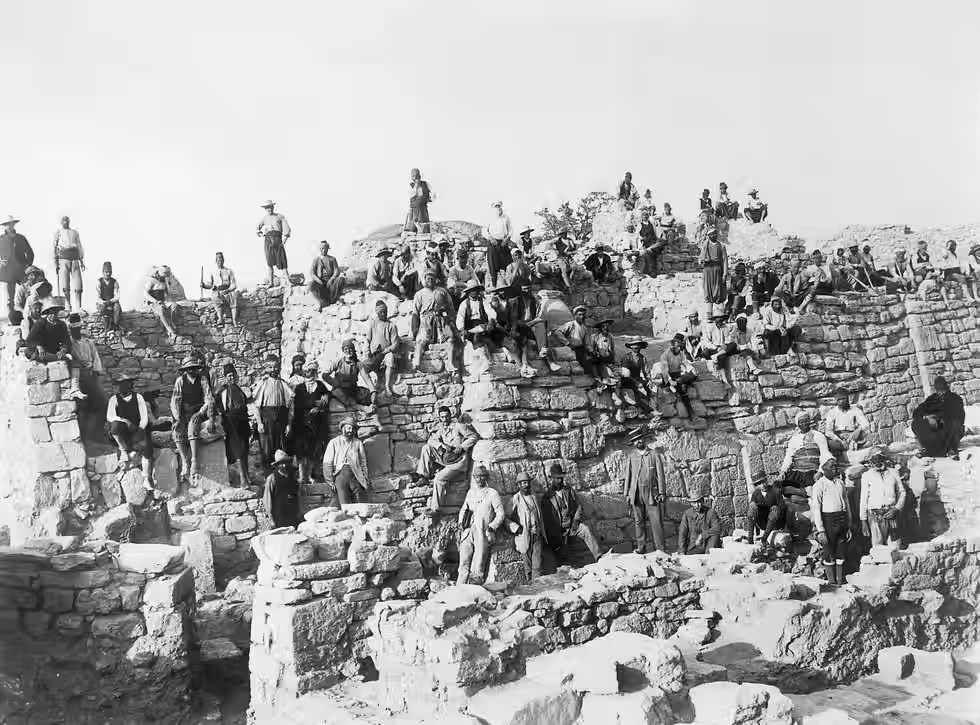
Despite these amateur mistakes, further study of the site at level 7 did reveal findings suggesting that this site was in fact the mythical Troy just not on the scale described by Homer. Far from it. But, partial credit should go to Schliemann. Despite his crude methodology, his work is considered foundational for Mediterranean archeology.
The top of the hill was the King’s palace. The view around was far reaching and stunning.


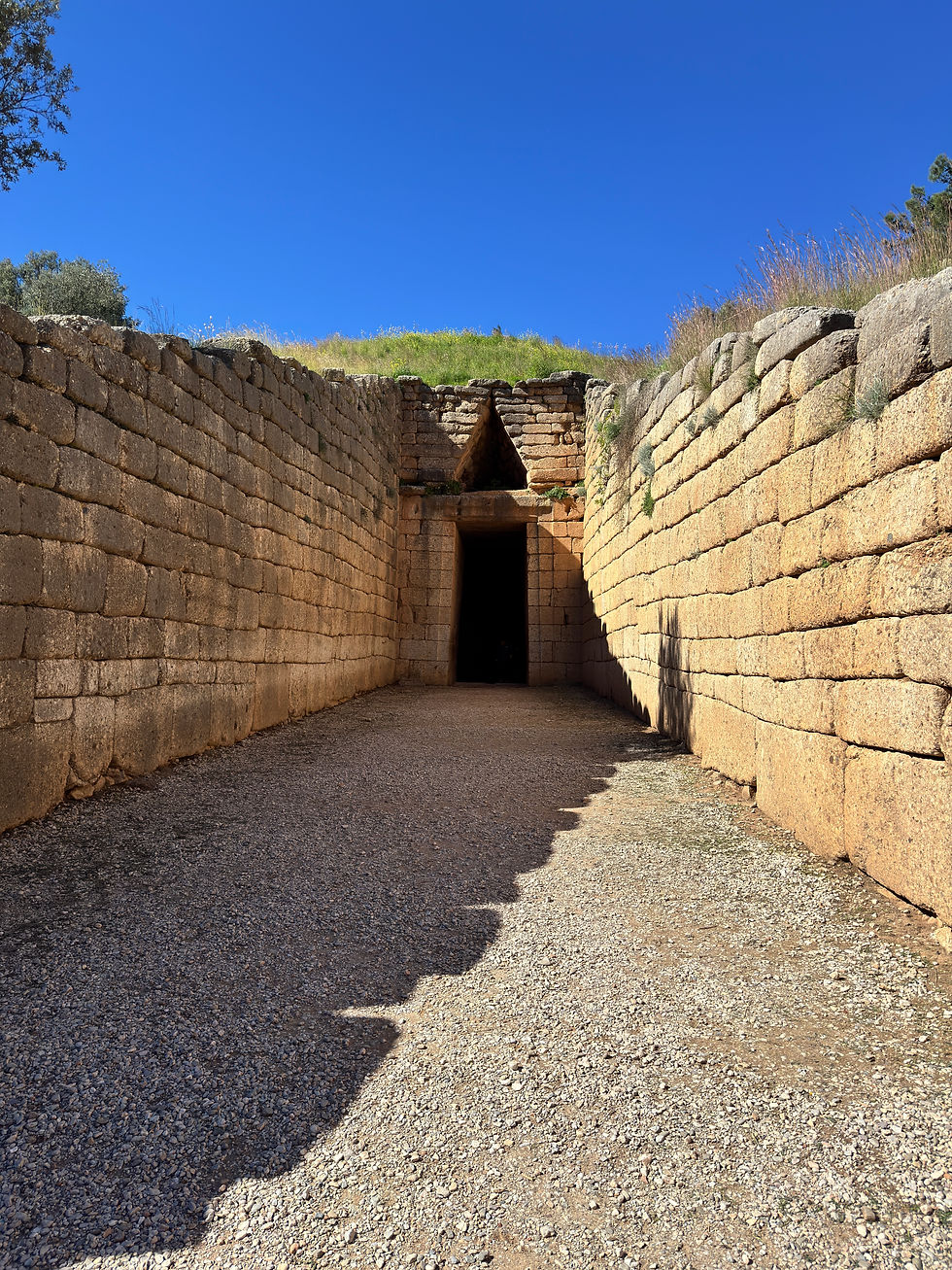
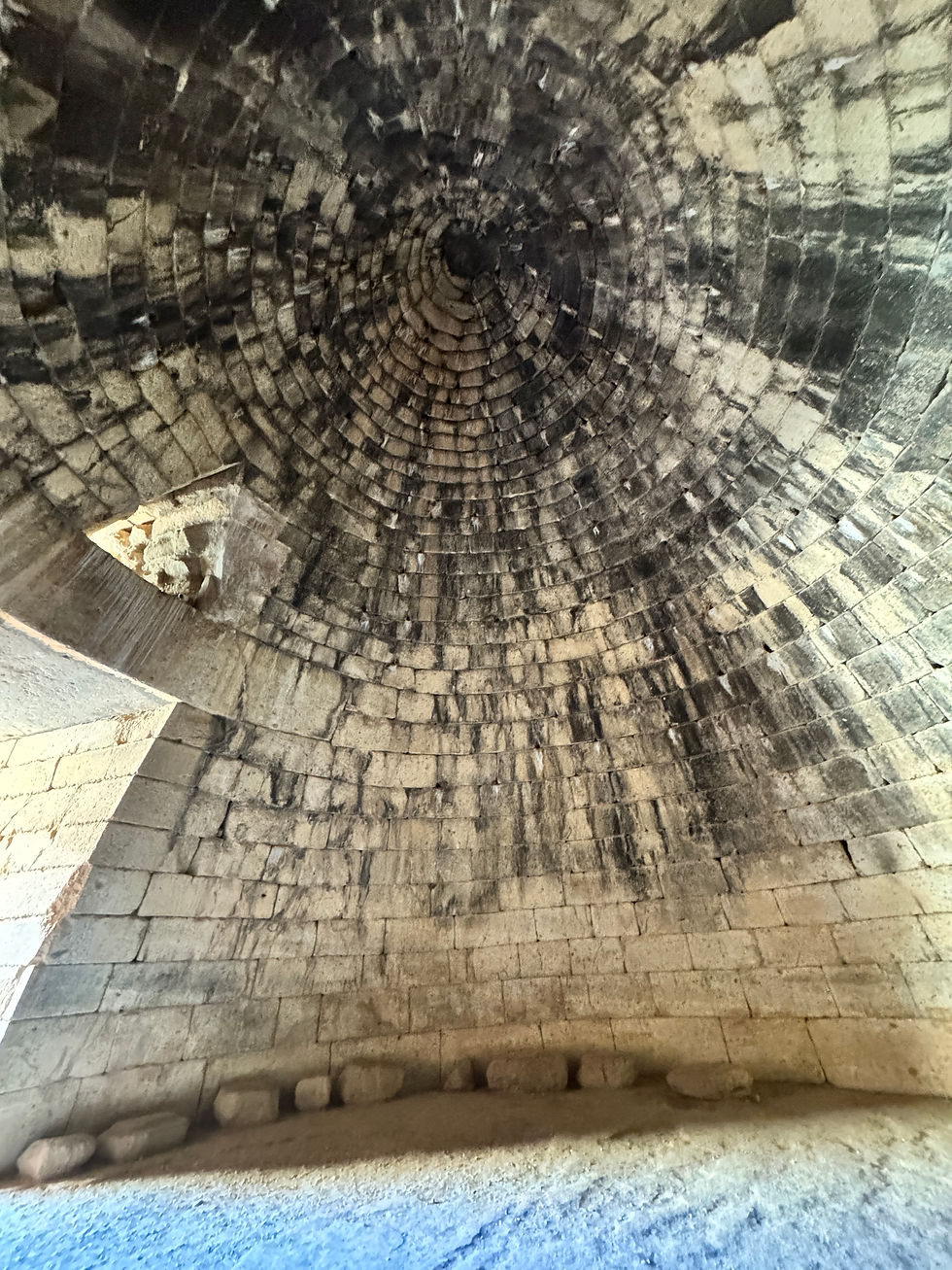
This domed burial chamber was huge for it’s time. It was built without any mortar or supporting structure in a large bee hive style. The entire thing is stacked stones, each slightly tilted inward more. There are no posts, no studs, and no mortar or other supportive element. All of the weight rests on the triangle structures above the two doors. It remained the largest built until later, more sophisticated Roman structures were built.



A brief synopsis of the Trojan War can be found by clicking here
So did the Trojan War happen? Lets get Cliff Clavin’s little brother Al. He knows a lot about Greeks.

Thanks Glenn. Well .....yes and no.
Scholarship does show that there was a conflict between Hisarlik (Troy) and likely Mycenae in the late Bronze age (around 1200 BCE). This conflict was likely a trade war or expansionist fight. The Mycenaeans were victorious and Troy was razed.
But the heroic aspects of the tale, while thrilling, was likely pure fiction. The is no evidence of Paris, Hector, Agamemnon , Achilles, Odysseus, Ajax, Helen of Troy, or a large wooden horse.
Homer did spin an epic yarn though.
Thanks Al.
And then, the Mycenaeans just vanished. We still don’t know for sure what happened but a short time after the conclusion of the story of the Trojan War, around 1200-1100 BCE, the Mycenaeans just disappeared. There are several theories but no proof. Was it a competing band or raiders, the so called “Sea Peoples” that later plagued the Egyptians (More on them later in this trip)? Was it an Earthquake, disease, failure of far reaching trade routes, collapse of the government? No one knows.

But the disappearance led to what became known as as The late Bronze Age collapse. Palaces were destroyed, literacy disappeared, and Greece entered a Dark Age that lasted over 400 years.
So, just as we puzzle over these rocks, so to did Iron Age Greek ‘tourists’ as they wandered over them millennia ago. Anything to get closer to the great story found in Homer’s tale.
Just like the fan boys of pre history, we look at these stones today and wonder who were these people? Were any of the stories true? Where did they go?


Comments