

The Place of the First Occasion

"The pyramids may be more stupendous and the Parthenon more beautiful... Yet in nobility of conception, in vastness of detail, in mystery of the highest order, [the Hypostyle Hall] surpasses them all."
— Amelia Edwards, 1877
During this episode we have visited a number of ancient ruins telling epic stories. As grand as they all have been none have hit has hard as The Luxor Temple and Karnak Temple here in Luxor Egypt.
Some background - Thebes is the ancient name for this Egyptian capital. Here in Upper Egypt - by convention the Southern Nile is referred to as “Upper” and the Northern delta as “lower” - Ancient Pharaohs made this region their capital. The reasons for this are many but mainly it was an effort to control both the upper and lower halves of the Kingdom under one rule. So for successive generations Pharaohs ruled here at the banks of the Nile and today over 60 Egyptian kings are buried here.

During the height of the of “The Middle Kingdom” - approximately 2050 BCE – 1710 BCE - Egyptian power and culture reached its zenith here.
And we are about to celebrate the 250th year of our country! That is nothing in the age of this empire.

After the decline of the ancient Egyptian civilization, centuries passed during which new peoples and languages came to dominate the region. By the time of the Arab conquest of Egypt in the 7th century CE, the ruins of Thebes’ temples were still massive and impressive. The Arabs were so struck by these monumental stone buildings that they called the area:
“Al-Uqṣur” (الأقصر) — meaning “The Palaces” or “The Fortresses.” Over time, Al-Uqṣur was simplified in European languages to Luxor — a name derived from the same root as “luxury” and “luxurious.”
So there are two great temples here in Luxor that alone make any journey worthwhile. These are The Luxor Temple and Karnak. We visited both today.
Both temples serve a similar purpose but had different missions. Both are dedicated to the Egyptian supreme deity Amun Ra. Amun was the god of the sun. He, along with his wife and son formed a holy trinity here.


The second purpose was propaganda. Each successive Pharaoh wanted to put his personal touch on each of these temples - Particularly Karnak - to say they too were divine and deserve all glory, honor, worship, and the right to rule.
This is Luxor Temple. It is the smaller of the two. Luxor served as the ceremonial temple for kingship, where pharaohs were believed to be divinely reborn. It was the destination for the annual Opet (New Year and Fertility) Festival procession from Karnak. It was mostly built by Amenhotep III (18th Dynasty, c. 1390 BCE) and expanded by Ramses II.
These temples were made mostly of sandstone which is a softer rock and easily susceptible to erosion. When Thebes was abandoned the silt and mud of the nearby Nile river built up and buried much of the the complex. This mud acted as a preservative and saved much of the structures until later excavation.


Above is the main gate. You will notice several mammoth statues to Rameses II (The Great). He was an extraordinarily long lived Pharaoh who reigned until he was 92 years old. He put his name and likeness everywhere so you will see him again and again and again.


There used to be two obelisks here. One was taken by Napoleon and is now in Paris.
The hieroglyphics are everywhere and at first feel very “Disney”. They are so clear and sharp that you almost feel like they were added on to give atmosphere. Except they were not. These are the real thing and it is remarkable to see them climb the walls telling usually the same story over and over again. This story was how remarkable the Pharaoh is and how lucky we are to have him in power.


In both of these temples, despite their great size, only the royal family, priests, and some nobles were allowed inside. Peasants never got to see the interiors.
And they were brightly colored in their day. Here and there you can see some surviving pigment.

Throughout both temples you will see again and again faces of the statues hacked off and sometimes the heads removed. These defacements were mostly the handiwork of Christians eager to purge what they perceived as paganism from the area. Churches and Mosques were built into the grounds to try to capture some of the ancient magic here as their own.


This is the great colonnade of Amenophis III, another warrior Pharaoh eager to tout his success. Each column is 19 meters long and once covered over by a stone roof.


As you make your way back you come into the original structures built here. This is the ‘Holy of Holies” where only the Priest would enter, make sacrifices and try to determine the will of Amun Ra.
Just outside the Holy sanctum is a clever chapel built 1000 years later yet separated by only a few feet. It was built by Alexander The Great when we conquered Egypt in the late stages of the Empire. Instead of tearing structures down as other invading armies had done, he embraced the local religion, dressed in native wear, and offered sacrifices. These actions greatly pacified the civilian population, as designed, and allowed him to take over Egypt easily.


However, Luxor is dwarfed by Karnak. This Temple complex extends over 400 acres and was the largest and most impressive religious center in the world for over 2,000 years.


This is not one temple but a series of religious and political buildings constructed by successive Pharaohs over 1,500 years. Like it’s little sister, Luxor, the huge space was reserved only for Royalty, Priests, and selected Nobles or VIP’s. Even though it was peasants and slaves that labored over the centuries to build the mammoth complex, they were never allowed inside once it was consecrated.


It was here that various Pharaohs would consolidate power and proclaim supremacy over everyone that came before. No one was more venerated than Rameses II (The Great). This was the Pharaoh portrayed so vividly in the largely fictional movie of “The Ten Commandments” by the late Yul Brenner.

Rameses put his name or statue on just about everything here. In fact he would deliberately carve hieroglyphics so deep that it would be difficulty for a rival to scratch them out when he passed on. He was determined to live forever and never be forgotten.
Just inside there is a courtyard where monuments and temples are found to various lesser Pharaohs including this chapel to Rameses III.

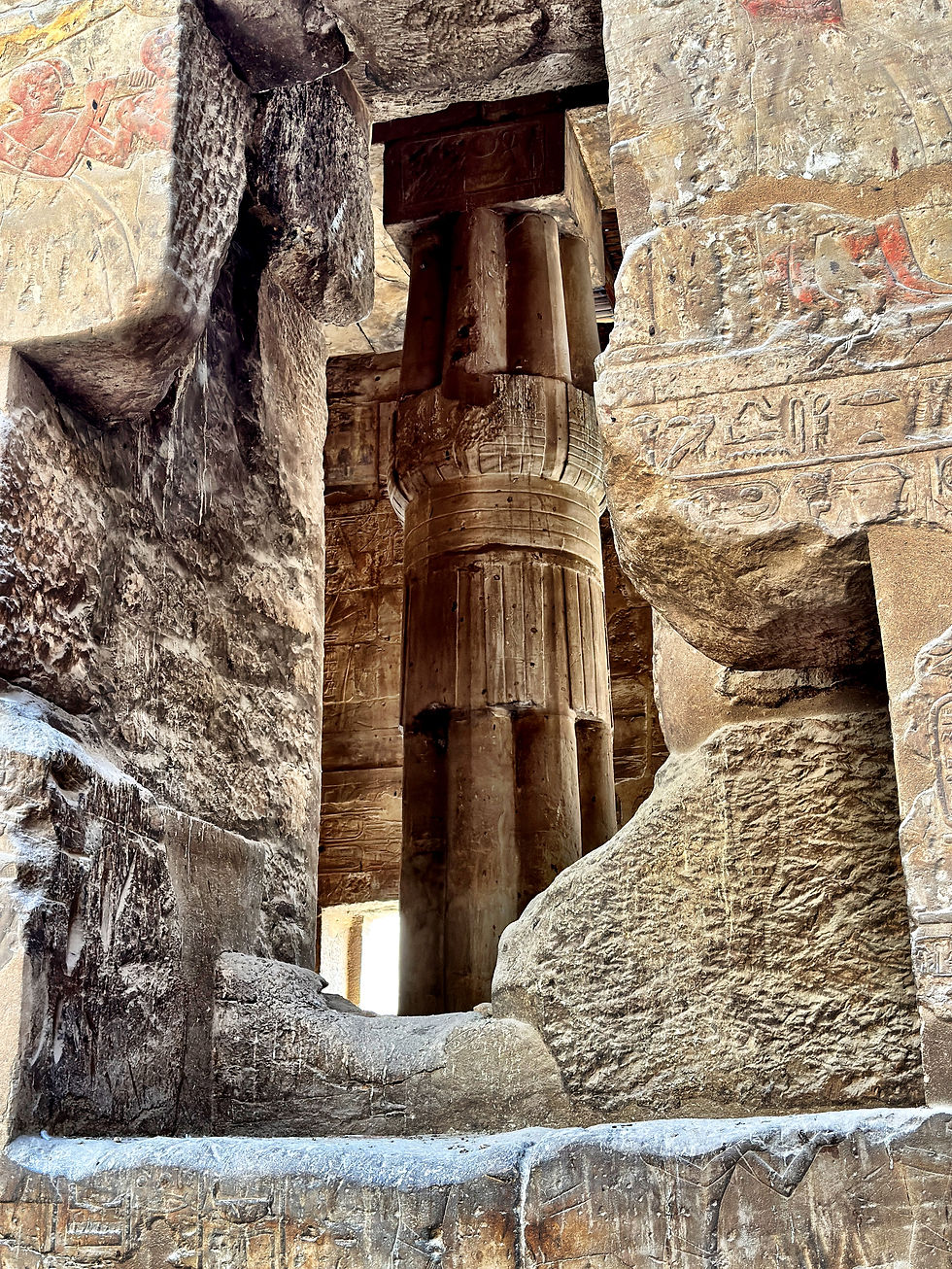
The centerpiece of this great treasure is the great Hypostyle Hall built by Rameses II. You walk into a forest of huge 35 meter tall columns, 134 in total. Each are festooned with hieroglyphics extolling Amun Ra and his relationship to Rameses that extend to the roof. It is a stunning triumph of engineering designed to invoke awe. It succeeds in that goal. Clever sunlit windows were added at great heights like primitive stain glasses to allow the sun (Amun Ra) to stream through adding drama to the scene.


As you progress through the forest of columns you eventually emerge into the Middle Kingdom Court. This was built earlier than the Hypostyle and features monuments to various other Pharaohs including Tutankhamun, Thuthmosis III, and Hatshepsut (the first female Pharaoh). There were many others. Every ruler wanted to be in here.


This was the Sacred Lake which contained fresh water. And below was a Scarab Beetle monument. The Scarab Battle was sacred to Egyptians indicating renewal, rebirth and good luck. You will notice below people walking in circles around it. It was said that if you complete seven revolutions around the beetle your wish will come true.

These huge obelisks of Hatshepsut, the female pharaoh who was supposed to serve as regent only for her young son, but decided she liked the job so much that she sent him away and continued as monarch until her death.


In all, Karnak was the largest religious complex ever constructed from 2055 BCE to 100 CE. It housed over 5,000 statues. The site was served by over 80,000 priests, workers, and attendants. It is rivaled only by Angkor Wat. Angkor Wat Temple was built circa. 13th century CE. Karnak has had temples since before 1971 BCE. Just the Hypostyle Hall alone covers 54,000 square feet and is large enough to hold the Cathedral of Notre Dame.

These temples were known as “The Place of the First occasion” when Amun Ra walked among his people.
Like then, the only fitting adjective to describe our visit was awestruck.
Oh and one more thing - this is what happens when you accept candy called "The Pharaoh's Special Gummies"


Comments